A few months ago, the Market Intelligence Committee published the FTTH Market Panorama report by Country. What specific actions is the committee taking to address the slow adoption rates highlighted in the report?
 The Market Intelligence Committee's new report on the FTTH Market Panorama, with a renewed layout, offers a clear and immediate representation of data, facilitating comparisons between countries, particularly on coverage and adoption. To address low adoption rates, the Market Intelligence Committee identifies the best-performing countries to analyze their success factors. By understanding the policies, strategies, and initiatives that have proven effective in these markets, the committee can extract actionable insights. This analysis will lead to the creation of a vademecum—a practical guide designed to assist countries with lower adoption rates. This resource will be developed with active input from Market Intelligence Committee members and structured through a standardized comparison grid, ensuring consistency and relevance. Additionally, the vademecum will serve as a critical tool for addressing challenges related to the copper switch-off, offering strategic recommendations and a roadmap for a smooth transition.
The Market Intelligence Committee also plans to monitor customer awareness of FTTH technology and its benefits in key markets. This will help identify gaps in understanding and support the design of targeted information campaigns in collaboration with association members. Through these combined efforts, the Market Intelligence Committee aims to drive adoption and foster a deeper appreciation of FTTH’s transformative potential.
Beyond publishing the annual market reports, what are the key activities of the Market Intelligence Committee? Additionally, how can members of the FTTH Council Europe benefit from participating in the committee's initiatives?
Beyond annual reports, the Market Intelligence Committee constantly analyses the FTTH market, both in terms of coverage and adoption, to understand status and the future evolution for every European Country. We try to detect and share with both other Members of the FTTH Council Europe and all the market stakeholder valuable market drivers, best practices and lessons learned from the data we gather.
One of the Market Intelligence Committee’s primary goals is to provide stakeholders with accurate, user-friendly reports that serve as decision-making tools. These analyses not only benefit the Association but also assist other committees in designing guidelines and implementing concrete actions to address market challenges. The Market Intelligence Committee’s data-driven approach ensures that its findings are practical, actionable, and impactful.
Market Intelligence Committee members benefit from a valuable exchange of know-how, technical expertise, and international experience, gaining new ideas and insights for their companies and countries.
Furthermore, the Market Intelligence Committee creates opportunities for professional development and high-level networking, enabling participants to enhance their influence within the FTTH ecosystem.
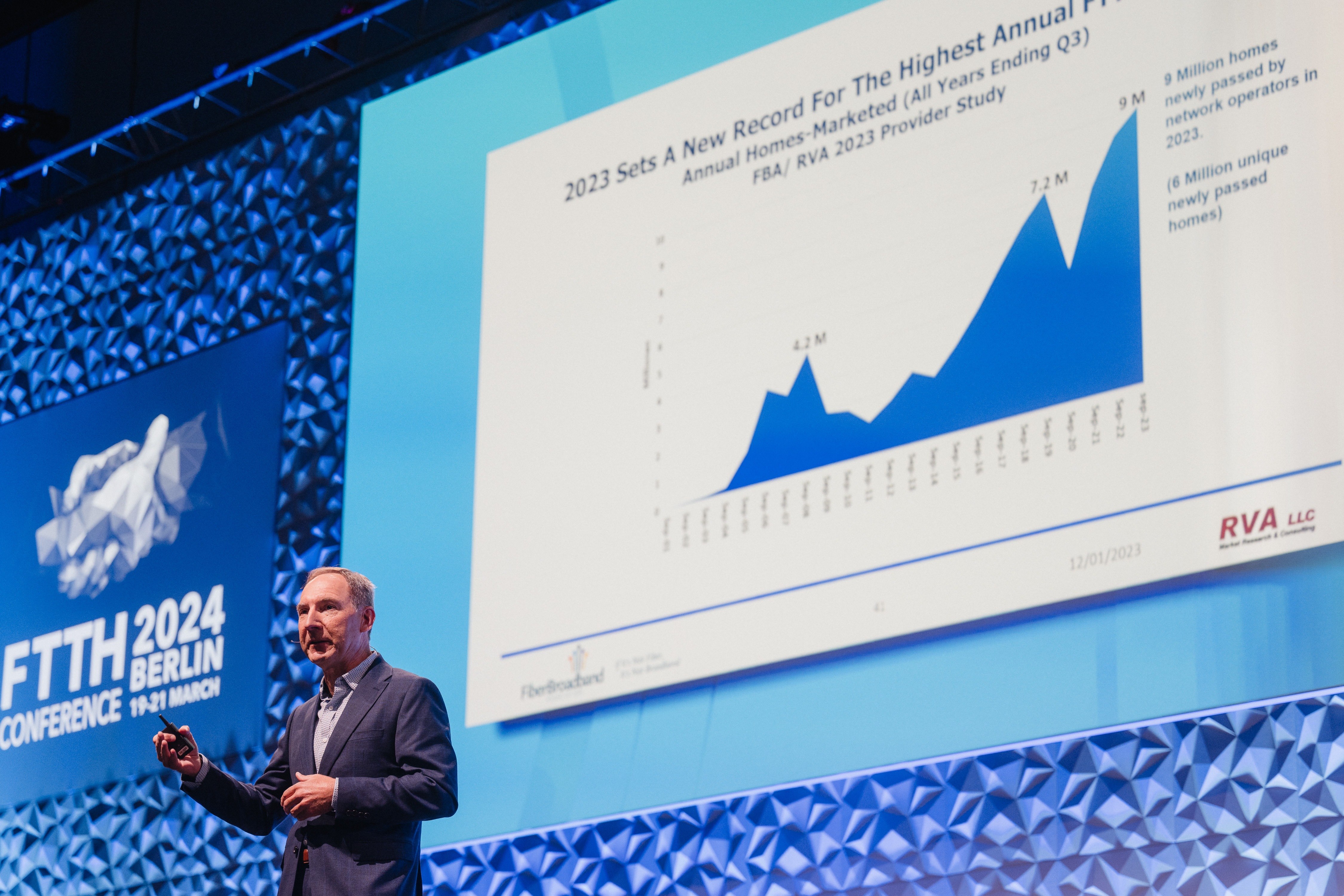
In the picture on the right, action from the Market Panorama panel at the FTTH Conference 2024, in Berlin.
During the recent FTTH Congress Balkans, you presented the latest market figures for FTTH rollout and adoption for the South-Eastern European countries, now part of the FTTH/B Market Panorama report. Where does the region stand in the road to full-fibre, compared to other European countries?
 The Balkan region shows strong interest in fiber optic development, as demonstrated by the successful FTTH congress in the Balkans. The adoption rate in some countries exceeds the European average, but the situation is heterogeneous. Albania, with 60% coverage and a take-up close to 90%, and Montenegro, with coverage and adoption above 70%, stand out positively. Bosnia-Herzegovina, on the other hand, is lagging with less than 10% coverage, although the take-up in covered areas is high. Kosovo is positioned midway, with 50% coverage and 41% take-up. Despite these disparities, the overall outlook for the region is positive. The Balkan market is characterized by dynamism and growth potential, making it a promising area for investment and development. By addressing barriers to adoption and fostering regional cooperation, the path to full-fiber connectivity can be accelerated.
In the picture on the left, action from the Opening panel at the FTTH Congress 2024, in Dubrovnik.
What do you value the most from your work at the FTTH Council Europe?
 The main value of participating in the FTTH Council Europe lies in the opportunity to interact with colleagues from different countries, with roles and experience in various sectors of the industry. This stimulating environment fosters the sharing of best practices and the development of new ideas, both for extending network coverage and accelerating take-up.
Participating in the FTTH Council Europe offers a uniquely enriching experience. The opportunity to collaborate with colleagues from diverse countries and sectors within the telecommunications industry is invaluable. This dynamic environment encourages the sharing of best practices, innovative solutions, and forward-thinking strategies, all aimed at driving network expansion and increasing adoption rates.
The collective mission to support members and raise awareness among stakeholders about the importance of FTTH creates a shared sense of purpose. By working together, we contribute to the broader goal of accelerating Europe’s transition to the Gigabit Society. This is achieved through the widespread deployment of FTTH networks, which serve as the backbone for digital transformation and innovation across the continent.
We find great satisfaction in contributing to initiatives that make a tangible impact on the industry and society. Whether it’s through sharing insights, shaping policy discussions, or fostering collaboration, my work with the FTTH Council Europe provides both professional growth and the opportunity to help position Europe as a global leader in digital connectivity. The chance to be part of this journey and to witness the transformative power of FTTH firsthand is what I value the most.
In the picture on the right, action from the Market Panorama panel at the FTTH Conference 2024, in Berlin.