Episode 3: the Women in Fibre Committee


Roshene McCool, Chair of the Women in Fibre Committee of the FTTH Council Europe, reveals the upcoming initiatives from the working group and what they are planning for the FTTH Conference 2023 in Madrid, where they will foster their mission of enhancing female representation within the fibre industry and making sure our sector can benefit the most from diversity in the workplace:

  1. What lead the FTTH Council Europe to establish this Committee in 2021?
  2. From your experience, are gender and diversity a barrier to progression in the fibre industry? 
  3. What are the best practices to foster diversity a the workplace?
  4. The new Champion of Diversity Award will be presented for the first time at the FTTH Conference 2023. Could you tell us more about this initiative and the criteria you adopted for the selection of the shortlisted candidates?
  5. Broadly speaking, what shall attendees of the FTTH Conference expect from the Women in Fibre committee? Would you give us any hint of the discussions you are planning?

Read the full interview below to get the answers to these questions.


What lead the FTTH Council Europe to establish this Committee in 2021?

The Committee was originally set up by Sue Guaglianone in 2020, while she was a Board Member of the FTTH Council Europe. Sue translated the urgent need for enhanced representation, shared by many female professionals engaged in the fibre industry, into an exciting working group, that has so far worked hard to establish a common baseline view of gender diversity and a series of industry best practices to improve the way the industry approaches inclusion and diversity-related topics.  I personally joined the Committee because I want to be a visible ally for women in the industry, and support other professionals willing to do the same.

From left to right in the picture: Sue Guaglianone, former Board Member of the FTTH Council Europe, and Merrion Edwards - Director Technology and Program Management Office at Corning, during the Women in Fibre workshop at the FTTH Conference 2022 in Vienna, Austria.

From your experience, are gender and diversity a barrier to progression in the fibre industry? 

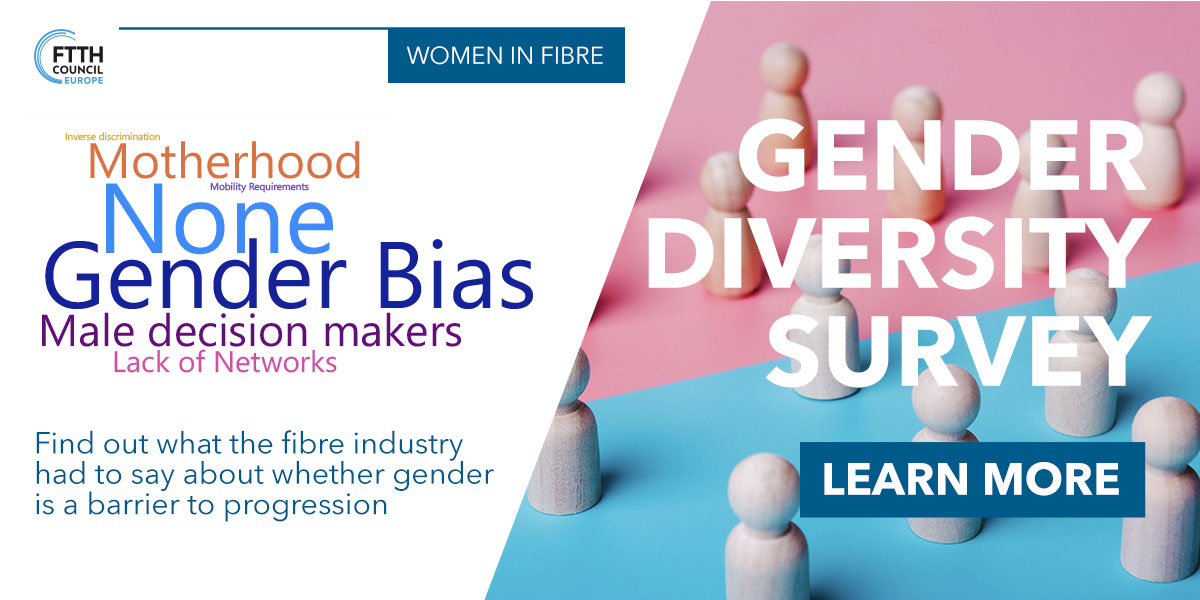
In my experience, yes they are. There are pockets of good practice where women are able to contribute their talents equally, but in other places, a patriarchal attitude still exists and prevents women from competing on an equal playing field with men. Our Gender Diversity Survey from 2021 demonstrated the way in which women are not rewarded for their long tenure in the same way as men and their access to opportunity and training is materially impacted by their gender. The FTTH Committee and Women in Fiber advocate for constructive change from within the industry., and we are strongly convinced that the future success of our industry depends on the ability to harness the best talent whatever their gender, religion, sexuality, or ethnicity.

What are the best practices to foster diversity a the workplace?

I’m an engineer, so I perhaps reflect my bias when I say we have to measure the numbers. Organisations need to measure and report their gender mix when it comes to access to training and opportunity, talent pipelines and recruitment. As a critical and basic starting point though, organisations need to make sure their workplaces are safe and that reporting of unacceptable behaviours is treated seriously. It is not possible to feel included if the staff does not feel safe.


The new Champion of Diversity Award will be presented for the first time at the FTTH Conference 2023. Could you tell us more about this initiative and the criteria you adopted for the selection of the shortlisted candidates?

The Champion of Diversity Award reflects the commitment of our working group to diversity in the fibre industry. We considered those aspects of diversity that reflected access to opportunity, such as access to training and return to work initiatives, as well as measurements of success, such as the % of women in senior positions and pay equity. Despite there is still a long way ahead for us before diversity will be fully respected in the workplace, we have been positively impressed by some of the nominations we received, and are confident that this initiative will contribute in fostering a more diverse and inclusive environment for all professionals. It only remains for me to invite you all to join the FTTH Awards Ceremony during the upcoming FTTH Conference 2023, where the Campion of Diversity Award winner will be officially presented!


Broadly speaking, what shall attendees of the FTTH Conference expect from the Women in Fibre committee? Would you give us any hint of the discussions you are planning?

The Women in Fiber Committee hopes to give those organisations who were short-listed for the Champion of Diversity Award the opportunity to share their best practice and experience to demonstrate what works for increasing diversity in the workforce; short-listed candidates will be speaking during the workshop we are hosting on 18 April at 11:30 CEST: Workshop 6B - Attracting talent to the FTTH industry – sharing best practice. We also hope this will allow delegates to hear what they should expect from their own organisations and inspire diverse talent to create change from within.  

But the engagement of the committee with the FTTH Conference is not limited to workshop day! Other than the above-mentioned FTTH Awards ceremony, where the Champion of Diversity Award will be presented for the first time ever on 19 April, our Committee Chair Christel Sandstedt will be moderating the session Panel 17 - Attracting talents to the FTTH industry, scheduled for 20 April at 14:00 CEST, where we will give the floor to leaders in charge of business and talent management, as well as financial strategies, for a comprehensive discussion on how to attract and manage talents in the FTTH industry, in a time when skilled labour shortage is felt as a crucial issue.

I very much look forward to seeing you all in Madrid for many fruitful discussions on diversity, inclusion, and talent management in the fibre optic industry.


More about Roshene McCool


Roshene is a Senior Market and Technology Development Manager for Corning Optical Fiber and Cable, specialising in single mode fiber and related applications. She provides technical and market insight for Corning’s global fiber and cable product line management teams. Roshene has 30 years of experience in engineering and optical communications systems and subsystems, including many years designing networks for advanced radio telescopes. Roshene has held project management and coordination lead roles in diverse teams through her career. Roshene is the acting chair of the Women in Fiber Committee for the FTTH Council Europe and is the winner of the Corning Optical Communications “You make a difference” award, 2022 for her leadership in diversity initiatives in Corning. Roshene holds a Masters Degree in Electrical and Electronic Engineering from the University of Nottingham, United Kingdom and is a chartered member of the Institution of Engineering and Technology (IET).


Use of a ground water heat pump (GWHP) to cool FTTx street cabinets

Member company: Eurofiber
Country or geographical scope: Global
Period: 2015-
Segment of the value chain concerned: Internet service provider
Product/service category involved: Street Cabinets

Abstract:
ISP’s can achieve significant reductions in their energy usage, and thereby reduce their greenhouse gas emissions, by switching to GWHPs to cool their street cabinets, rather then using conventional air conditioning. In addition GWHPs require less maintenance reducing the amount of truck rolls needed for service.


Context

As a sector we are well aware that every party has a responsibility to reduce their carbon footprint. Digital services are often a way to reduce the need for travel or transport of physical goods. However digitization itself is not currently free of its own impact on the environment. Therefor as a sector we must act to reduce our own footprint as well. We cannot however do this alone and we believe that by sharing best practices we can help and inspire others to go beyond their current efforts, ultimately to the benefit of all society.
 

Solutions

Active equipment used by the broadband service can require cooling to ensure uninterrupted service. Traditionally this has been done by using conventional air conditioning. This is an effective method of cooling, however it requires addition power, and thus carbon emissions. An alternative that has been used by Eurofiber for its street cabinets is to cool them by using a ground water heat pump (GWHP) instead. What a GWHP does is to keep the air in the street cabinet stable by pumping up ground water from a well deep in the earth. The temperatures there are relatively stable at around 15 °Celsius year round. By pumping this water through a heat exchanger the GWHP can cool during the summer and provide heat during the winter, which also eliminates the need for a separate heater. A GWHP has a very low energy consumption and requires little maintenance, which reduces their footprint further by reducing the amount of truck rolls.


Results

Eurofiber has been able to use GWHP systems to cool some of their street cabinets. Given the need to dig fairly deep to reach ground water of the correct temperature this is not always feasible. Where it is possible it works very well though, energy consumption at peak is only 3% of what a conventional air conditioned street cabinet would use and maintenance costs are much lower, making it an ideal solution.
 

Conclusions

As enablers of digitization the broadband sector is already doing much to help other reduce their footprint. We must however as a sector do more and also look at our own footprint. An important step in this is the transition to full fiber networks. However even fiber networks use active equipment that requires cooling. The example of using ground water heat pumps is an example of how we can reduce our own carbon footprint by both reducing our energy usage and reducing the need for maintenance.

More episodes from this series


Help us create a brighter future!

Join the Fibre Council Europe
today and benefit from Europe’s
largest ecosystem of fibre players